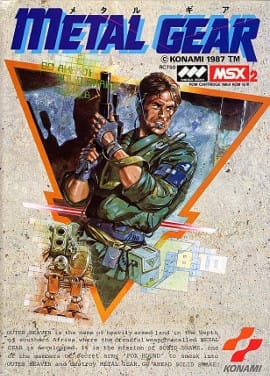
Metal Gear
Konami · Since 1987
The series that invented the stealth genre. Hideo Kojima's Metal Gear debuted on the MSX2 in 1987, turning the era's hardware limits into a game about avoiding capture rather than shooting — and grew into one of gaming's most cinematic, story-driven franchises.
Metal Gear began in 1987 as a Konami game for Japan's MSX2 home computer, and it was the first title directed by Hideo Kojima. The stealth premise was born partly from constraint: the MSX2 could put only a limited number of bullets and enemies on screen at once, which Kojima felt made straightforward combat unsatisfying. Inspired by the prisoner-of-war film The Great Escape, he reversed the usual objective — instead of shooting through enemies, the player, as the infiltrator Solid Snake, had to avoid them, sneaking past guards and evading detection. Kojima described the goal as capturing "the tension of hide and seek," and in doing so he laid the foundation of an entire genre. The series' early history was tangled. Metal Gear's success led to two 1990 sequels developed separately: Snake's Revenge, made for the NES for Western markets without Kojima's involvement, and Metal Gear 2: Solid Snake, Kojima's own MSX2 response that advanced the stealth systems considerably. It was the leap to the PlayStation, however, that made Metal Gear a global phenomenon. Metal Gear Solid (1998) reintroduced the series in 3D with voice acting, cinematic direction, and a densely plotted story about nuclear deterrence and genetic destiny, and it became one of the defining games of its generation. Kojima went on to direct the series for 28 years, through to Metal Gear Solid V: The Phantom Pain in 2015. Across that span, Metal Gear became known not only for pioneering stealth mechanics — line-of-sight, alert states, non-lethal options, environmental concealment — but for an authorial ambition unusual in games: long cinematic cutscenes, dense geopolitical and philosophical themes, fourth-wall-breaking moments, and recurring characters whose arcs stretched across decades of real-world time and a convoluted in-fiction chronology. Metal Gear's influence is twofold. Mechanically, it established stealth as a core video-game vocabulary, and nearly every later stealth game — and the stealth sections embedded in countless non-stealth games — descends from the systems Kojima prototyped on 1980s hardware. Culturally, it was among the strongest early arguments that games could carry serious, complex, author-driven storytelling, making Kojima one of the medium's few designers with genuine name recognition among the general public.