Tank
1974 · Action · Arcade
Overview
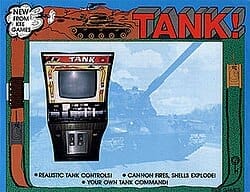
Tank is a 1974 two-player arcade game from Kee Games, a subsidiary of Atari, and was one of the first games to use ROM chips to store sprite graphics. Two players each control a tank from an overhead perspective and try to shoot each other while navigating a maze of obstacles. The game was notable for being one of the first to use graphical sprites rather than simple geometric shapes, giving the tanks a more detailed appearance than contemporary games. Tank was a significant commercial success for Atari and helped establish the two-player competitive arcade game as a genre.
Deep Dive
Tank was designed by Lyle Rains and drew on the success of earlier Atari multiplayer games. The game stored its tank sprite graphics in ROM chips — a significant technical innovation for its time when most games drew shapes using analog circuits. Four different game modes offered variations on the basic formula, including a single-player mode where one player faces CPU-controlled tanks. The overhead maze design with destructible walls added tactical depth that pure shooting games lacked. Tank was so popular that Atari created Tank II and several sequels. Its technical approach to sprite storage influenced nearly all subsequent arcade game design and established patterns that are still used in game development today.
Developer Story
Tank was developed by Lyle Rains and Kee Games (a subsidiary of Atari) in 1974. It was one of the first games to use ROM chips for storing sprite graphics, allowing more detailed visuals than previous games. The two-player tank combat format was immediately popular and spawned numerous sequels and imitators. Tank was also one of the first games to feature multiple levels of difficulty.
Did You Know?
- Tank was among the first arcade games to use ROM chips to store graphical sprites, allowing more complex visuals than hand-wired logic circuits could produce.
- The game offered four playfield variations and multiple difficulty settings — unusual depth for a 1974 arcade game.
- Its two-player simultaneous combat format directly influenced Combat on the Atari 2600, which was bundled with the console at launch.
- Kee Games was secretly owned by Atari — the subterfuge allowed Atari to offer "competing" products to distributors who demanded exclusivity.