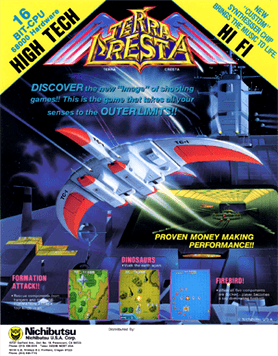
Terra Cresta
1985 · Shooter · Arcade
Overview
Terra Cresta is a 1985 vertically scrolling shooter video game developed and published by Nihon Bussan for arcades. The player controls a flying craft to destroy the Mandler army before they destroy all of humanity. Gameplay involves shooting enemies and collecting different ship parts that each provide their own unique weapon, such as a wave gun or a double shot.
Deep Dive
Terra Cresta is a 1985 vertically scrolling shooter video game developed and published by Nihon Bussan for arcades. The player controls a flying craft to destroy the Mandler army before they destroy all of humanity. Gameplay involves shooting enemies and collecting different ship parts that each provide their own unique weapon, such as a wave gun or a double shot. It is the sequel to the 1980 fixed shooter Moon Cresta, Nihon Bussan's first big hit in arcades, and the second installment of the Cresta series.
Developer Story
Terra Cresta was developed by Nihon Bussan (Nichibutsu) in 1985 as a sequel to Moon Cresta. Players collected sections of a combined spacecraft, assembling a larger vessel with more firepower. The formation system — five sections that combined into a powerful combined form — was the game's central mechanic. Nichibutsu was a smaller Japanese arcade developer whose games were popular in Europe.
Did You Know?
- Terra Cresta's five ship sections could combine in different formations for different attack patterns — strategic assembly was part of the game.
- The full combined ship could execute a screen-clearing Phoenix attack, but splitting the ship was sometimes more useful for navigating tight spaces.
- Moon Cresta, Terra Cresta's predecessor, was one of the most cloned games of the early 1980s — Nichibutsu's formation concept was highly influential.
- The game's European distribution was stronger than its Japanese commercial performance — Nichibutsu found a significant audience in British arcades.