Lunar Lander (1969)
1969 · Simulation · PDP-8
Overview
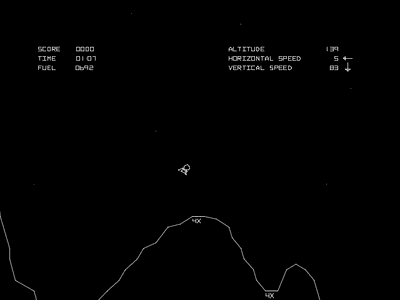
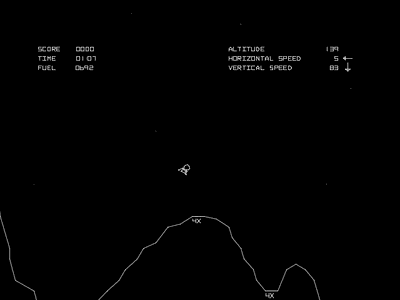
Lunar Lander is a genre of video games loosely based on the 1969 landing of the Apollo Lunar Module on the Moon. In Lunar Lander games, players control a spacecraft as it falls toward the surface of the Moon or other astronomical body, using thrusters to slow the ship's descent and control its horizontal motion to reach a safe landing area. Crashing into obstacles, hitting the surface at too high a velocity, or running out of fuel all result in failure.
Deep Dive
Lunar Lander is a genre of video games loosely based on the 1969 landing of the Apollo Lunar Module on the Moon. In Lunar Lander games, players control a spacecraft as it falls toward the surface of the Moon or other astronomical body, using thrusters to slow the ship's descent and control its horizontal motion to reach a safe landing area. Crashing into obstacles, hitting the surface at too high a velocity, or running out of fuel all result in failure. In some games in the genre, the ship's orientation must be adjusted as well as its horizontal and vertical velocities.
Developer Story
The original Lunar Lander simulation was written in 1969 by Jim Storer, a high school student in Lexington, Massachusetts, as a class project. He programmed it in FOCAL on a PDP-8 minicomputer. His teacher Don Rutherford helped him refine it. The program was never commercially distributed but spread through the research community on paper tape. It inspired numerous versions throughout the 1970s and eventually Atari's 1979 arcade game.
Did You Know?
- Storer wrote the game the same year as the actual Apollo 11 moon landing, capturing the national fascination with lunar exploration.
- The original version was text-only — players typed thrust values and received printed altitude and velocity readings.
- Because it was distributed on punched paper tape and later typed from magazine listings, dozens of independent versions with different features emerged throughout the 1970s.
- The physics simulation in Storer's original was surprisingly accurate, using real equations of motion for the lunar descent.
- A version appeared in the 1973 book "What to Do After You Hit Return" and became one of the most-typed programs in early computer history.